

I’m sure that’s the burning question on the mind of every reader of this blog.
And I have a confident answer: yes.
I already thought so, based on my amateur acquaintance with the history of technology, but I’m still more convinced after visiting the Kotsanas Museum this afternoon—a lovely little institution in a prosperous neighborhood of Athens that features reconstructions of ancient Greek machines, musical instruments, armor, and games.
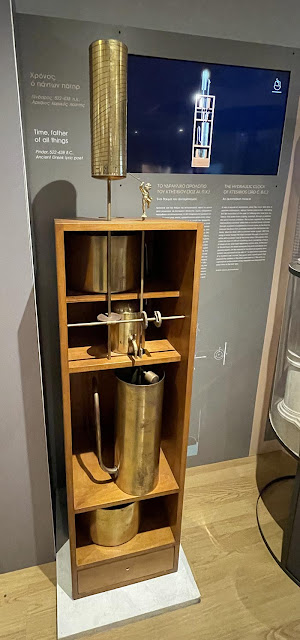
Greek philosophers and mathematicians were driven by the desire to understand, but they also wanted to construct devices that could be amusing or useful. Plato reportedly invented this water-driven alarm clock:

Other highlights of the museum (not in chronological order) include this more sophisticated hydraulic clock invented by Ktesibios (3rd c. BC) …
… a pantograph (for miniaturizing drawings) invented by Heron (1st c. AD) …


This ancient “robot” was designed by Phylon of Alexandria (3rd c. BC). It pours water and wine into a cup. It’s an example of many ancient inventions that were intended to amaze and entertain rather than for strictly practical purposes. (Such devices could be used in theaters and temples, whenever you needed a deus ex machina.)

The most impressive surviving piece of ancient technology is the Antikythera mechanism, recovered from a shipwreck in 1901, which I saw yesterday at the National Archaeological Museum. (Click these photos to enlarge them if you wish.)


Ancient Greek technology peaked in the Hellenistic period, between Alexander the Great and the Roman conquest of Greece. Its center was probably Alexandria, famous for its scholars and library. Many of these engineering achievements were not reproduced until the late medieval or early modern era. (Mark Petersen offers a wonderful science-fictional answer to why ancient technology got derailed in his contribution to Backspaces.)


If a gifted ancient inventor had conceived the idea of a keyboard typewriter, I bet he could also have worked it out. It would take a lot of time and skill to build such a thing, but there were very fine craftsmen who made precision gears and who had the ability to make objects as delicate as this golden headdress (the size it appears on a laptop screen is about actual size).

I don’t think the ancients had coiled springs or mechanical escapements, but they knew how to use weights and hydraulic pressure to drive mechanisms, and whoever was clever enough to devise the Antikythera mechanism could have devised an escapement too. Nothing essentially stood in the way.


But what about the scholars of Alexandria, who had plenty of papyrus and wrote with ink on scrolls? Didn’t one of them ever dream about a typewriter?


Wonderful post! I had heard of the Antikythera mechanism (a favorite exhibit piece in the ancient-aliens-visited-us and everything-you-learned-is-wrong books that were so popular when I was a kid in the 1970s), but none of the others. Many of these achievements seem particularly remarkable when I consider that all those precision gears had to be individually hand-forged. No factories as we know them! (What a mindblower it was to me in college when I realized that the ancient Greeks and Romans had virtually all the technologies and abilities as had, say, Benjamin Franklin.)
Very interesting inventions. Thanks for the post.
One of the predecessors to computer controlled machines I got to examine one day was a huger vertical milling machine that was fully automatic. The gear box that ran it at various speeds and feeds was a gigantic gear filled box that looked like the most fantastic clockworks ever built. I'm sure if a machine from the early 20th century (which is still operating daily today) could be built, the Greeks could have made a typewriter.
Some of the S&Gs use a weight rather than a spring. I agree it was definitely possible but the expense would have been astronomical. Probably would be a one off for a king… but it totally could have been done.
I went down a fascinating rabbit hole the other day of the function of ancient Egyptian and Roman locks and keys. They even had padlocks.
I guess the ancient Greeks just didn't have the modern urge to speed things up.
As you know the Ancient Greeks had very interesting ideas about writing and memory.
But I'm also thinking of the familiar question about the Romans having all the technology required to make steam engines, but didn't. The confluence to make things like that happen is more modern perhaps, and the result of many players often working on the same idea… a scenius effect maybe.
Keep up the Greek posts!